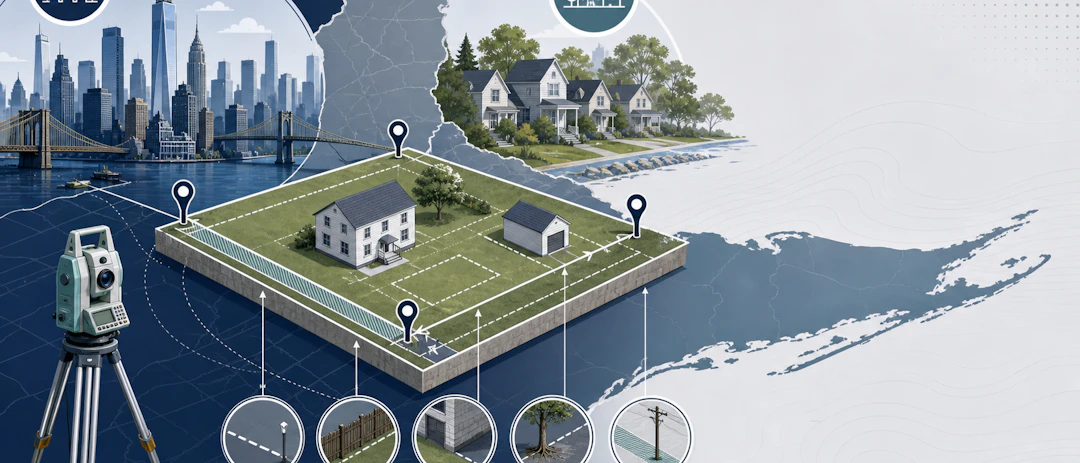
Understanding Property Surveys in New York: NYC vs. Long Island, Common Property Issues, and Why Surveys Matter
When purchasing or selling real estate in New York, one of the most valuable tools for understanding a property's legal boundaries is a professional land survey. While title searches establish legal ownership, surveys provide a physical representation of the property—revealing lot lines, fences, trees, structures, encroachments, and other conditions that can directly affect ownership rights.
At Liberty Land Abstract, surveys are an important component of many transactions. They help attorneys, lenders, buyers, and sellers identify potential title issues early, allowing problems to be addressed before closing.
What Is a Property Survey?
A property survey is a professional drawing prepared by a licensed land surveyor that identifies the physical characteristics and legal boundaries of a parcel of land.
A survey typically illustrates:
- Property boundaries
- Lot dimensions
- Buildings and improvements
- Fences
- Trees near property lines
- Driveways
- Sidewalks
- Utility easements
- Rights-of-way
- Encroachments
- Neighboring structures
Unlike a title search, which reviews public records, a survey compares the legal description of the property with what actually exists on the ground.
Together, the title search and survey provide a more complete picture of the property's legal and physical condition.
Why Surveys Matter During a Real Estate Transaction
Many property issues cannot be discovered by reviewing deeds alone.
A survey can identify:
- Structures crossing property lines
- Fence encroachments
- Shared driveways
- Trees located directly on lot lines
- Building additions extending beyond legal boundaries
- Easements affecting future improvements
These findings often determine whether additional documentation, corrective action, or underwriting approval is needed before closing.
Types of Surveys Used in New York
Different transactions require different levels of detail. Common survey types include:
Title Survey
Prepared specifically for real estate transactions, a title survey focuses on property boundaries, easements, improvements, and potential encroachments that may affect ownership or title insurance.
ALTA/NSPS Survey
Most often used for commercial properties, ALTA/NSPS surveys provide a comprehensive review of:
- Boundary lines
- Easements
- Rights-of-way
- Utilities
- Improvements
- Access points
- Zoning considerations
Because commercial transactions typically involve greater financial exposure, lenders frequently require an ALTA survey.
Architectural Survey
Architectural surveys focus on existing buildings and structures, helping identify dimensions and existing improvements before renovations or redevelopment.
Topographic Survey
Topographic surveys illustrate elevation changes, drainage, grading, vegetation, and natural features. They are commonly used for new construction and site planning.
Understanding Lot Lines
One of the primary purposes of a survey is establishing the property's legal lot lines.
Lot lines define where ownership begins and ends.
Although many owners assume fences or landscaping mark property boundaries, that's not always the case.
A survey frequently reveals that:
- Fences are several feet inside—or outside—the true property line.
- Driveways partially cross neighboring lots.
- Retaining walls extend onto adjacent properties.
- Landscaping improvements have been installed beyond the legal boundary.
Without an accurate survey, these issues may remain undiscovered until closing—or even years after purchase.
Trees and Property Lines
Trees are among the most common sources of neighbor disputes.
Questions often include:
- Who owns a tree located on the property line?
- Can overhanging branches be trimmed?
- What happens if roots damage neighboring property?
While surveys identify the tree's location relative to the lot line, determining legal rights often depends on New York property law and the specific circumstances.
For title professionals, knowing whether a tree sits entirely on one property or directly on the boundary can be important when evaluating ownership questions and potential disputes.
Fence Encroachments
Fence encroachments are among the most common survey issues found during residential transactions.
Examples include:
- A backyard fence extending beyond the legal property line
- A neighbor's fence located partially on your property
- Decorative walls crossing lot boundaries
- Retaining walls extending onto adjoining parcels
Sometimes these encroachments have existed for decades without dispute.
However, they may still affect:
- Property ownership
- Future improvements
- Financing
- Title insurance underwriting
Understanding Encroachments
An encroachment occurs when a structure or improvement extends onto neighboring property without legal authority.
Common examples include:
- Fences
- Garages
- Decks
- Roof overhangs
- Steps
- Driveways
- Air conditioning units
Not every encroachment creates a title defect, but each should be carefully evaluated before closing.
Survey review helps determine:
- How significant the encroachment is
- Whether legal agreements exist
- Whether corrective action is necessary
Out-of-Possession and Adverse Possession Issues
Occasionally, surveys reveal that someone has occupied or maintained land beyond their legal property boundaries.
Historically, these situations sometimes led to claims of adverse possession.
New York law governing adverse possession has evolved over time, particularly following statutory changes enacted in 2008. Survey evidence, fence locations, and long-standing boundary conditions often play an important role in evaluating these claims.
Although adverse possession claims are relatively uncommon, survey findings may prompt further legal review before a transaction proceeds.
Boundary Line Agreements and Fence Affidavits
When survey issues arise, several documents may help resolve ownership questions.
Depending on the circumstances, attorneys may prepare:
- Boundary Line Agreements
- Fence Affidavits
- Easement Agreements
- Access Agreements
- Encroachment Agreements
These documents help clarify property rights and may satisfy title underwriting requirements before closing.
Surveys in the Five Boroughs
Property surveys in New York City often differ significantly from those on Long Island.
Because of dense development and older buildings, surveys in Manhattan, Brooklyn, Queens, the Bronx, and Staten Island commonly focus on:
- Attached structures
- Party walls
- Shared driveways
- Air rights
- Encroachments
- Narrow lot dimensions
- Historic improvements
Urban properties frequently involve buildings constructed decades—or even centuries—ago, making careful survey review especially important.
Surveys on Long Island
Long Island surveys generally involve larger parcels and different property concerns.
In Nassau and Suffolk Counties, surveyors more commonly encounter:
- Larger setbacks
- Detached homes
- Pools
- Sheds
- Septic systems
- Wells
- Fences
- Tree lines
- Waterfront setbacks
- Conservation areas
Rather than party walls and dense development, Long Island surveys often focus on open land, accessory structures, and boundary improvements.
Common Documentation Used During Recording and Closing
When survey issues are identified, additional documentation may be required before documents are recorded or title insurance is issued.
Depending on the transaction, this may include:
- Updated surveys
- Survey affidavits
- Boundary line agreements
- Fence affidavits
- Easement agreements
- Corrective deeds
- Restrictive covenant documents
- Municipal approvals
- Recorded releases
- Title curative documents
These materials help ensure the public record accurately reflects the property's legal status and support a smoother recording process.
Why Local Expertise Matters
Every New York property tells a different story.
A brownstone in Brooklyn presents different survey challenges than a waterfront home in Suffolk County or a townhouse in Manhattan.
Working with an experienced title company helps identify potential survey concerns early, coordinate with surveyors and attorneys, and resolve issues before they become closing delays.
At Liberty Land Abstract, our team works closely with buyers, sellers, attorneys, lenders, and survey professionals throughout New York to ensure transactions move forward with confidence.
The Bottom Line
A property survey is far more than a map—it is a critical tool for understanding ownership, protecting property rights, and avoiding costly disputes.
From lot lines and fence encroachments to trees, easements, and adverse possession concerns, surveys often uncover issues that cannot be identified through public records alone.
Whether you're purchasing property in one of New York City's five boroughs or on Long Island, partnering with an experienced title company helps ensure survey findings are properly reviewed, documented, and resolved before closing—providing greater confidence for everyone involved in the transaction.
This article is for informational purposes only and does not constitute legal advice. Survey requirements, property rights, and title matters vary by transaction and jurisdiction. Parties should consult qualified legal, surveying, and real estate professionals regarding their specific circumstances.